Sponsored article
What features distinguish the roman chasuble from other liturgical garments?
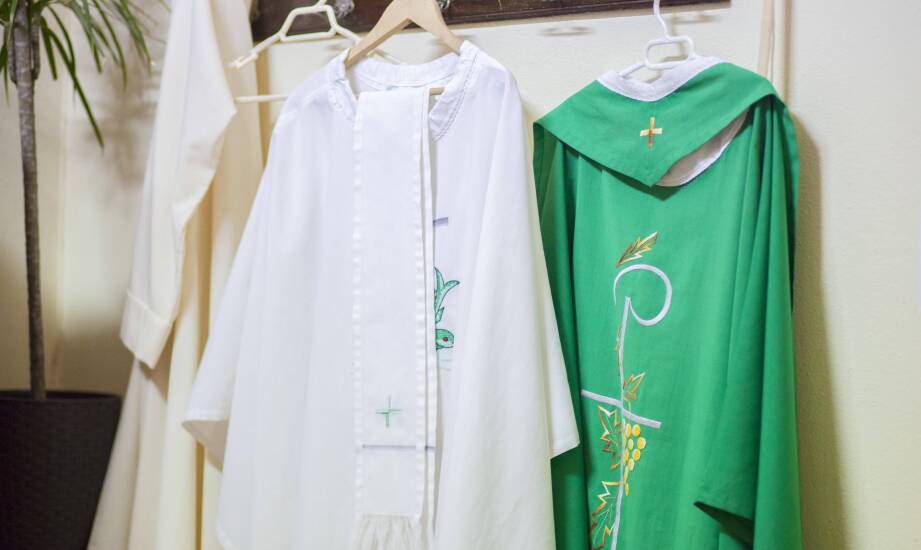
In Church liturgy, form never exists independently of content. Every garment, its cut, proportions, and decoration, constitutes an element of an ordered language of symbols that establishes the importance of the celebration and emphasizes its sacred character. The Roman chasuble holds a special place in this tradition – as an expression of consistency, discipline of form, and deep roots in the classical understanding of liturgical aesthetics. It is a garment chosen consciously, with a focus on the clarity of the sign, the gravity of the rite, and respect for the centuries-old heritage of the Church.
Why does the Roman cut distinctly stand out from other forms of chasubles?
The Roman chasuble is distinguished primarily by its well-defined cut, which distinctly sets it apart from freer forms, such as the gothic chasuble. Its construction is shorter and narrower on the sides, preventing it from hanging widely over the celebrant's shoulders and arms. This form is not accidental – it stems from Roman tradition, which emphasizes clarity of gestures and vivid symbolism. The Roman chasuble does not dominate the silhouette, but visually organizes it, giving the celebration a more formal, classical character, recognizable even from a great distance.
What role does decoration play in a Roman chasuble?
In the Roman chasuble, decoration is not an accessory but a central bearer of theological content. Instead of an expansive fabric surface, decorative vertical bands are used, usually symmetrically placed on the front and back of the garment. Embroidery, appliqué, or a band with motifs of the cross, IHS, or Eucharistic symbols draw the eye to the center, highlighting the sacred dimension of the liturgy. Such solutions are characteristic of the creations offered by Ars Sacra, where emphasis is placed on the coherence of form, symbol, and material, without excessive ornamentation.
How do tradition and functionality create a coherent whole?
The Roman chasuble is an example of a garment where form is subordinated to both tradition and liturgical practice. Its compact design encourages focus, does not distract with the movement of fabric, and allows for full control of gestures at the altar. Simultaneously, the use of high-quality materials, linings, and complete liturgical sets enhances the sense of continuity and order in the celebration. Thus, the Roman chasuble remains a conscious choice – for those who appreciate precision, symbolic moderation, and timeless aesthetics.
The Roman chasuble as a consistent form of tradition and symbol
The Roman chasuble is distinguished by a clearly defined cut that refers to classical liturgical tradition and organizes the silhouette of the celebrant through narrow proportions and a shortened form. Subsequently, decoration plays a key role – focused, axial, and symbolic, designed so the sign is clear and theologically unequivocal. The whole is completed by functionality resulting from liturgical experience: gesture control, discipline of form, and high-quality workmanship. Consequently, the Roman chasuble remains a cohesive combination of tradition, aesthetics, and conscious liturgical choice.
You might be interested

How to choose the right colour scheme for custom bar mats?

Innovations in Plastic Sealing: The Example of TERMA Sealers

Modern printing techniques in the production of cardboard stands